
Granite is durable, but the way it is cleaned still matters. For everyday care, remove loose debris first, use a gentle cleaner appropriate for granite or natural stone with a soft cloth, then dry the surface rather than leaving moisture behind. Avoid abrasive tools and be cautious with acidic cleaners, including vinegar and lemon-based solutions, because the stone's mineral composition and any treatment applied to it can affect how it responds.
This guide covers a simple routine for cleaning granite countertops, what to avoid, how to deal with streaks and surface marks, and when a problem may need more than routine cleaning.
- Remove crumbs and loose debris before wiping.
- Use a soft microfiber cloth and a cleaner suitable for granite.
- Avoid abrasive powders and rough scouring pads.
- Do not assume a homemade acidic cleaner is suitable simply because it is natural.
- Dry the surface after cleaning to help prevent streaks and residue.
The Best Way to Clean Granite Countertops
The best everyday method is straightforward: clear the surface, remove loose debris, apply an appropriate cleaner, wipe gently, and finish with a clean dry microfiber cloth. The goal is to remove everyday grease, fingerprints, crumbs, dust and spills without creating unnecessary wear on the finish or leaving product residue behind.
Granite is a natural material, and not every slab has exactly the same mineral composition, finish or treatment. The Natural Stone Institute recommends understanding the particular stone before choosing cleaning products and notes that some acids and abrasives can affect natural stone. If you are unsure about a newly installed or unusual surface, follow the care guidance provided by the fabricator or stone supplier.
What You Need to Clean Granite Safely
A soft microfiber cloth
A clean microfiber cloth is useful because it lifts everyday residue without the aggressive action of a rough scrubber. Keep a second dry cloth nearby for the finishing pass.
A cleaner suitable for granite and natural stone
Choose a formula intended for the surface you are cleaning. A product being described as natural does not automatically make it appropriate for every material. Surface compatibility matters.
A clean, dry cloth for finishing
Drying and lightly buffing after cleaning helps remove remaining moisture and residue, which can otherwise show as streaks on polished stone.
How to Clean Granite Countertops Step by Step
1. Remove crumbs and loose debris
Clear appliances and objects from the area you want to clean. Wipe away crumbs, grit and loose particles before applying cleaner. This prevents debris from being dragged across the surface while you wipe.
2. Apply your granite-safe cleaner
Follow the directions on the product you are using. Avoid saturating seams, edges or areas around fixtures unnecessarily.
3. Wipe the surface gently
Use a clean microfiber cloth and work across the countertop in manageable sections. For greasy areas or fingerprints, give the cleaner enough contact time to loosen the residue according to its directions rather than reaching immediately for an abrasive pad.
4. Check high-use areas
Look around the cooktop, coffee station, sink and preparation areas, where oils, watermarks and fingerprints tend to accumulate. Repeat the normal cleaning step if needed rather than scrubbing aggressively.
5. Dry and buff the surface
Finish with a clean, dry microfiber cloth. This simple step is particularly useful on dark or highly polished granite where water or cleaner residue can be more visible.
What Should You Never Use on Granite Countertops?
Granite is resilient, but routine care should still be considered. The safest approach is to avoid products or tools that are unnecessarily harsh for the job.
| Use caution with | Why |
|---|---|
| Vinegar and acidic DIY cleaners | Acids can affect some granite minerals and may also be incompatible with treatments applied to the stone. |
| Lemon or strongly acidic cleaners | Natural does not necessarily mean suitable for stone. |
| Abrasive powders or creams | Abrasives can scratch or dull some stone finishes. |
| Rough scouring pads | They can create unnecessary abrasion on a polished surface. |
| Unfamiliar strong chemicals | Check compatibility with your particular stone and any sealer or treatment first. |
The Natural Stone Institute specifically cautions that products containing lemon, vinegar or other acids may dull or etch certain natural stones and that abrasive scouring products can scratch some stones. Its guidance also notes that granite varies, so compatibility with the particular stone and any treatment matters.
Can You Use Vinegar to Clean Granite?
Vinegar is not a good default choice for routine granite care. Although granite is generally more acid-resistant than calcareous stones such as marble, the Natural Stone Institute cautions that some granite species contain trace minerals that can be attacked by acidic solutions. Sealers or other treatments can also react differently.
That makes vinegar a good example of an important home-care principle: an ingredient can be familiar and natural without being the right choice for every surface. When the stone's exact composition or treatment is unknown, a purpose-made, compatible cleaning routine is the more considered approach.
Can You Use Dish Soap on Granite?
For routine cleaning, mild dishwashing liquid diluted in warm water is commonly recommended. Consumer Reports, for example, recommends warm water and mild dishwashing liquid for daily granite cleaning, followed by drying with a microfiber cloth.
The trade-off is convenience and finish. Too much soap or incomplete rinsing can leave a film, particularly on dark polished stone. If you use dish soap, keep the amount modest and remove residue thoroughly. A purpose-made granite cleaner can simplify the routine when you want a ready-to-use formula designed around stone care.
Using a Purpose-Made Granite Cleaner
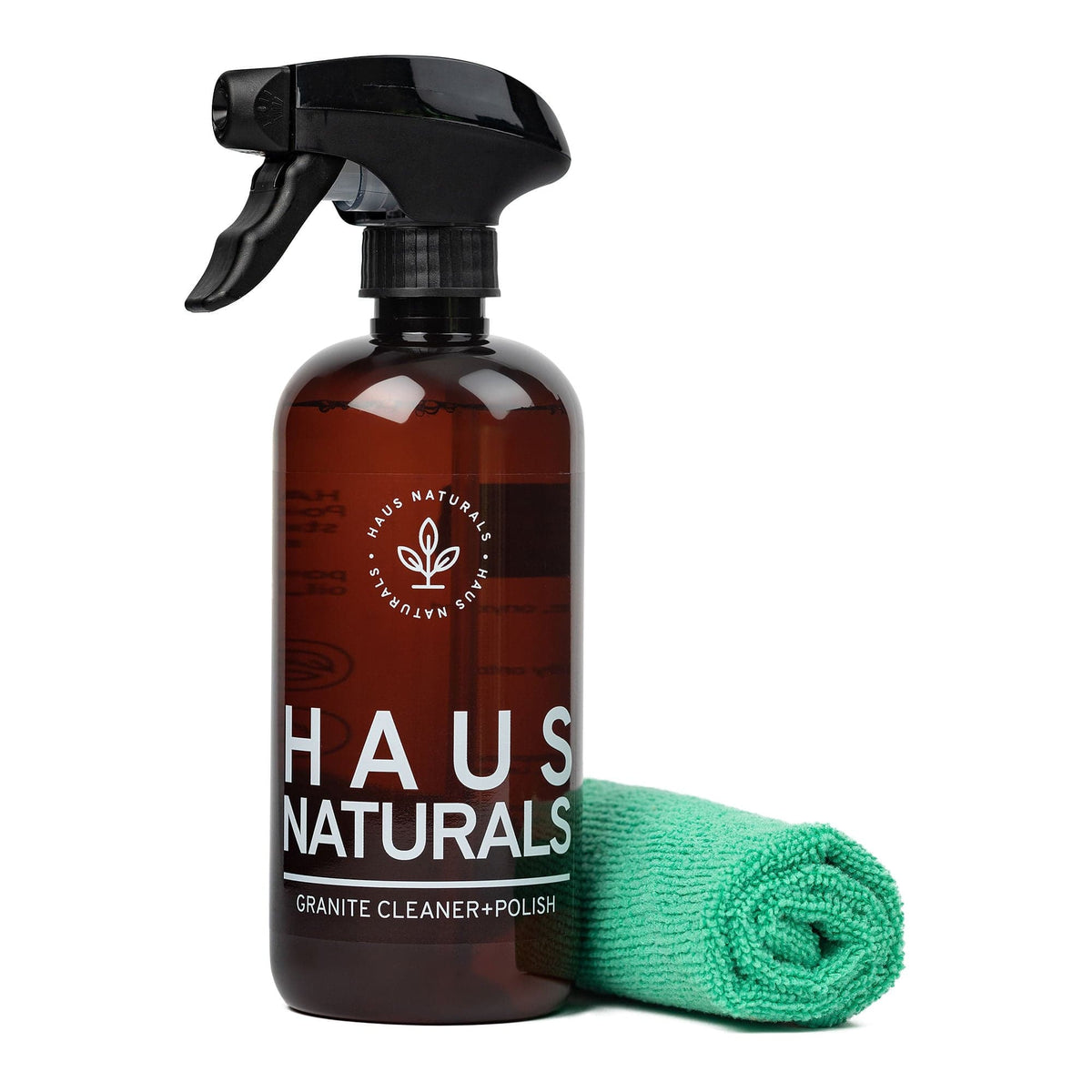
For regular care, a dedicated granite cleaner removes the need to mix a solution each time and makes it easier to keep one consistent routine. Haus Naturals Granite Cleaner & Polish is made for everyday granite and stone care, helping lift grease, fingerprints, watermarks, dust and dirt while leaving surfaces clean, polished and well cared for.
The aim is not to turn routine cleaning into a restoration treatment. A daily cleaner is for surface care. Deep staining, physical damage, etching or a failed sealer are different problems and may require specialist treatment.
Explore Granite Cleaner & Polish
How to Clean Granite Without Leaving Streaks
Streaking is often caused by excess cleaner, soap residue, hard-water deposits or simply allowing the surface to air-dry unevenly. Start with a clean cloth, avoid over-applying product, and finish with a separate dry microfiber cloth.
If the surface still looks hazy, do not automatically add more polish. First determine whether the haze is removable residue or a change to the stone's finish. Persistent dull patches that do not improve with normal cleaning can indicate a different care issue.
How to Remove Stains From Granite Countertops
Surface dirt and a stain that has penetrated the stone are not the same thing. Wipe spills promptly, especially strongly colored liquids and oils, to reduce the chance of staining. If a mark remains after normal cleaning, identify what caused it before choosing a treatment.
Some set-in stains may require a stone-specific poultice or professional attention. Avoid promising yourself a quick fix with increasingly aggressive household chemicals. If the countertop is valuable, the stain is extensive, or you are unsure about the stone, contact the fabricator or a natural-stone professional.
How to Keep Granite Looking Polished
- Wipe spills promptly rather than allowing them to sit.
- Use cutting boards rather than cutting directly on the countertop.
- Avoid abrasive cleaners and scrubbers for routine care.
- Dry the surface after cleaning to reduce visible residue.
- Keep grease and product buildup from accumulating around high-use areas.
- Follow the stone supplier's guidance on sealing or other periodic maintenance.
Good granite care is less about repeatedly adding shine and more about maintaining a clean surface without unnecessary abrasion or buildup.
Does Granite Need to Be Sealed?
Not every granite countertop has the same sealing requirement. The Natural Stone Institute notes that many stones do not require sealing and describes stone-industry sealers more accurately as impregnators that make stone more stain resistant rather than stain proof. Consumer Reports similarly notes that most granite does not necessarily need sealing, while a suitable sealer can add moisture resistance.
If your countertop was sealed, follow the product or fabricator's maintenance instructions rather than assuming it must be resealed on a fixed annual schedule. When water behavior changes or you are unsure of the existing treatment, consult the supplier before applying another product.
Frequently Asked Questions
What is the safest way to clean granite countertops?
For everyday care, remove loose debris, use a soft cloth with a cleaner appropriate for granite or mild dish soap and water, then dry with a clean microfiber cloth. Follow the stone supplier's guidance if the surface has a special finish or treatment.
Can you use an all-purpose cleaner on granite?
Only if the cleaner is suitable for the particular granite surface and its directions support that use. An all-purpose label alone does not establish compatibility with natural stone.
How often should granite countertops be cleaned?
Clean spills when they happen and wipe high-use areas as needed. There is no benefit in using more product or cleaning more aggressively than the surface requires.
How do you make granite countertops shine?
Begin by removing grease, residue and watermarks, then dry and lightly buff with microfiber. If the stone remains dull after cleaning, the issue may be the finish or treatment rather than dirt.
How can you tell if granite needs to be resealed?
Sealing requirements vary by stone and product. Follow the fabricator or sealer manufacturer's instructions. Do not assume every granite surface needs annual resealing.
A More Considered Approach to Stone Care
The most useful rule is simple: clean the material you actually have, not the cleaning trend of the moment. Granite is durable, but thoughtful product choice, gentle tools and a consistent routine help preserve the finish without making everyday care complicated.
Explore the Haus Naturals Home Care collection for considered cleaning essentials, or read our Ingredient Standard to learn more about how we approach the formulas used around the home.